
- All
- Product Name
- Product Keyword
- Product Model
- Product Summary
- Product Description
- Multi Field Search
Views: 0 Author: Site Editor Publish Time: 2025-12-13 Origin: Site


Elastomeric foam materials are widely used in HVAC insulation systems due to their flexibility, thermal insulation capability, and ease of installation. Among these materials, NBR/PVC closed-cell foam and open-cell EPDM foam represent two structurally different insulation approaches.
This article provides a technical comparison of these two materials, with particular emphasis on aging resistance, moisture interaction, thermal stability, and mechanical performance under typical HVAC operating conditions. Standardized testing methods and representative performance data are referenced to support material selection decisions focused on long-term reliability rather than initial performance alone.
HVAC insulation materials are continuously exposed to thermal cycling, humidity, airflow, and mechanical stress. Over time, these conditions contribute to material aging, which may result in:
Reduced thermal efficiency
Increased condensation risk
Loss of mechanical integrity
Higher maintenance and replacement costs
The dominant aging mechanisms in HVAC insulation are often moisture-driven, rather than purely chemical degradation of the polymer. Therefore, both material formulation and cell structure must be considered when evaluating long-term insulation performance.
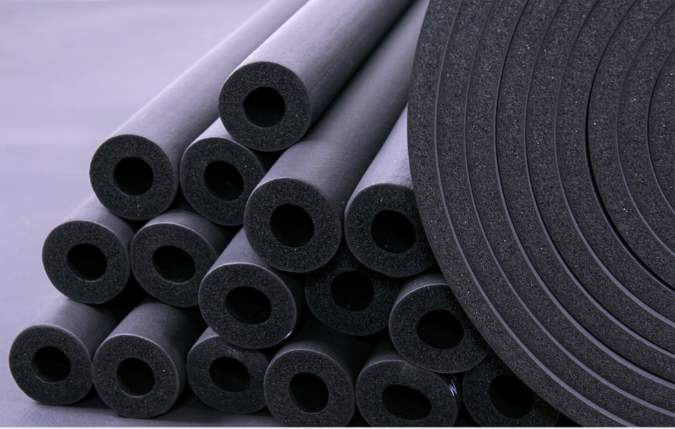
NBR/PVC foam is produced by blending nitrile rubber (NBR) with polyvinyl chloride (PVC) and processing the compound through controlled foaming and vulcanization. The resulting foam features a predominantly closed-cell structure, which restricts air and moisture movement through the material.
Typical HVAC forms include:
Pre-formed pipe insulation
Insulation sheets and rolls
Sealing strips and gaskets
Open-cell EPDM foam is manufactured from ethylene propylene diene monomer (EPDM) rubber using a foaming process that creates an interconnected cellular structure. This structure allows air to move freely through the foam, influencing both acoustic and moisture behavior.
In HVAC systems, open-cell EPDM foam is typically applied where flexibility or sound absorption is required and condensation control is not the primary concern.
The aging performance of NBR/PVC foam is strongly influenced by its closed-cell structure. By limiting oxygen and moisture penetration, internal oxidative degradation is reduced.
Under standard indoor HVAC conditions, NBR/PVC foam generally maintains:
Dimensional stability
Compression recovery
Consistent insulation thickness
Prolonged exposure to UV radiation or elevated ozone levels may accelerate surface aging if protective measures are not applied.
At the polymer level, EPDM rubber exhibits excellent resistance to oxidation, ozone, and heat aging. However, the open-cell structure permits continuous air and moisture exchange.
Over extended service periods in HVAC environments, this may lead to:
Increased internal moisture retention
Gradual softening under cyclic humidity exposure
Changes in mechanical response under compression
As a result, aging in open-cell EPDM foam is often driven by environmental interaction rather than polymer degradation alone.
The closed-cell structure of NBR/PVC foam provides:
Low water absorption
Effective water vapor resistance
Reduced condensation risk
These properties are critical in chilled water pipes, cold air ducts, and high-humidity HVAC systems.
Open-cell EPDM foam allows moisture and air movement throughout the foam body. In systems operating below ambient dew point temperatures, this can result in:
Moisture accumulation
Increased effective thermal conductivity
Higher long-term maintenance requirements
Additional vapor barriers are often necessary to control condensation.
Thermal insulation performance in NBR/PVC foam remains relatively stable due to:
Limited moisture ingress
Reduced convective heat transfer
Consistent cell morphology
Initial thermal insulation performance may be acceptable; however, performance is more sensitive to environmental conditions. Moisture uptake and air permeability can increase heat transfer over time.
Reliable sealing performance in wrapped or clamped installations
Open-cell EPDM foam shows high initial elasticity but may experience gradual compression deformation under sustained load, affecting long-term insulation thickness consistency.
Performance Category | Test Reference / Condition | NBR/PVC Closed-Cell Foam | Open-Cell EPDM Foam |
Cell Structure | — | Predominantly closed-cell | Open-cell, interconnected |
Primary Aging Mechanism | — | Moisture-limited oxidative aging | Moisture-driven environmental aging |
Heat Aging Resistance | ASTM D573 / ISO 188 | Tensile retention: 75–85% | Tensile retention: 85–95% |
Ozone Resistance | ASTM D1149 | Slight to no surface change | No visible cracking |
Moisture Absorption (by volume) | ASTM C1104 | ≤ 5% | ≥ 20% (structure dependent) |
Water Vapor Permeability | ASTM E96 / ISO 2528 | Low | High |
Condensation Risk in HVAC | System-level evaluation | Low | Elevated without vapor barrier |
Initial Thermal Conductivity | ASTM C518 | 0.034–0.038 W/m·K | 0.038–0.042 W/m·K |
Thermal Conductivity After Aging | ASTM C518 + humidity exposure | Minimal change | Noticeable increase |
Thermal Performance Stability | Long-term operation | Stable | Environment-sensitive |
Compression Set | ASTM D3575 | ≤ 30% | 35–50% |
Thickness Recovery | ASTM D3575 | Good | Moderate |
Mechanical Stability Over Time | Long-term installation | Stable geometry | Gradual softening possible |
Acoustic Absorption Potential | Qualitative (structure-based) | Limited | Good |
Typical HVAC Applications | Engineering practice | Chilled water pipes | AHU acoustic insulation |
Maintenance Requirement | Field observation | Low | Medium to high (humidity dependent) |
Expected Long-Term Insulation Reliability | System-level assessment | High | Application dependent |
From a long-term HVAC system perspective:
NBR/PVC closed-cell foam provides greater resistance to moisture-driven aging and more stable insulation performance over extended service life.
Open-cell EPDM foam offers superior polymer-level resistance to ozone and thermal aging but is more sensitive to environmental moisture due to its open-cell structure.
Effective HVAC insulation design should prioritize dominant aging mechanisms, moisture control requirements, and long-term operational conditions, rather than initial material properties alone.


